
Language teaching tips

  • 5 Activities to Teach English with Mr Men in London

    A Ready-to-Use A2-A2+ Unit

    5 activities to teach English with Mr Men in London

    Mr Men in London by Roger Hargreaves is, on the surface, a picture book. In practice, it’s a goldmine for A2-A2+ secondary students: a real narrative, rich vocabulary, cultural content about London landmarks, and enough Mr Men chaos to keep a class genuinely entertained. Planning a cultural sequence before the summer break? This one holds up.

    I built this unit to do two things: give students a memorable encounter with a real English book, and sneak in solid grammar and vocabulary work while they’re having fun. Yes, both at the same time.

    Here’s how it works.

    Key takeaways

    ✅ A full unit built around a real picture book, no invented texts

    ✅ Past simple taught in context, not in isolation

    ✅ A jigsaw structure that puts every student in expert mode

    ✅ Animal idioms with a cross-cultural twist students won’t forget

    ✅ A creative final task they actually want to finish

    Why Mr Men in London works for A2-A2+ learners

    Picture books aren’t just for young learners. For A2-A2+ secondary students, they offer something textbooks rarely do: a real text, written by a real author, with visual support that makes comprehension accessible without dumbing anything down.

    Mr Men in London gives you:

    • A natural past simple context: the narrative is packed with past tense verbs used meaningfully, which makes grammar work feel purposeful rather than arbitrary
    • Rich cultural content: London landmarks, British settings, recognisable characters your students already know
    • A readable length as students can encounter the whole book in a single lesson without feeling overwhelmed
    • Built-in humour, which, at secondary level, is never a disadvantage

    The unit takes students from first encounter with the book all the way to producing their own Mr Men story. It works beautifully as an end-of-term project, a London or travel-themed cultural week, or a standalone unit whenever you want something different from the textbook.

    Activity 1: Hook & Activate

    Best for: Opening the unit, building anticipation, activating prior knowledge.

    Why it works: Students arrive at a text with more energy when they’ve been made curious first. Mystery images and a quick knowledge check give them a reason to care before the book even appears.

    How to use it:

    1. Show mystery images connected to London and the Mr Men characters but don’t reveal the book yet.

    2. Run a stand-to-signal activity to surface prior knowledge: “Stand up if you’ve heard of Mr Men.” “Stay standing if you’ve ever seen a London bus.” You get the idea.

    3. Reveal the book. Set up a KWL chart as a class and students fill in the Know and Want to know columns together.

    4. Read the book aloud, or have students follow along. Keep it light. This is the discovery part.

    What students get: A low-stakes, high-curiosity entry point. By the time grammar work begins, they’re already invested.

    Activity 2: Story comprehension

    Best for: The lesson after the initial reading, checking global understanding before zooming in on language.

    Why it works: At A2 level, whole-story understanding has to come before detail work. Students need to hold the narrative in mind before you ask them to do anything analytical with it.

    How to use it:

    • Run a whole-class discussion: what happened? Which character did what? Where did they go in London?
    • Use open, guiding questions to check understanding — not an interrogation, a conversation.
    • Students complete the Learned column of their KWL chart.

    What students get: A shared, clear understanding of the story.

    Activity 3: Past simple through the story

    Best for: Grammar work with students who are just discovering the past simple or who know the rules but aren’t using them yet.

    Why it works: Grammar lands differently when it comes from a text students already know and care about. Instead of drilling isolated sentences, students are noticing and reusing language they’ve genuinely encountered in context.

    How to use it:

    • Draw students’ attention to the past tense verbs in the book. There are a lot and this is part of what makes Mr Men in London so useful for grammar work.
    • Work on form and meaning: how do we build the past simple? What does it tell us here, in this sentence?
    • Students practice using past simple to tell their own story at the end of the unit.

    What students get: Grammar in context, not in isolation. The book becomes the reference point which makes it far easier to remember than a random example sentence from a worksheet.

    Activity 4: Jigsaw WebQuest, becoming London experts

    Best for: Building research skills in English, structured speaking practice, cooperative learning.

    Why it works: The jigsaw model is one of the most effective cooperative structures available because every student has a role that matters. There’s no hiding. And the London angle gives students something genuinely worth researching, especially before the summer.

    How to use it:

    1. Divide the class into 4 groups. Each group receives a WebQuest focused on a specific topic from the book: transport, London landmarks, British culture, and Mr and Little Miss characters.

    2. Each group becomes the class expert on their topic. They research, take notes, and prepare an intermediate task: a poster or a guessing game to present to the rest of the class.

    3. Groups present. The rest of the class takes notes because collective consolidation tasks come next and everyone is accountable.

    4. Run whole-class consolidation activities to ensure every student retains what each group shared.

    What students get: Real research practice in English, genuine speaking time for every student, and a reason to actually listen when their peers present.

    Activity 5: Animal idioms and the comparative of equality

    Best for: Vocabulary enrichment, grammar (comparative of equality), cultural awareness, character description writing.

    Why it works: Idioms are the vocabulary students remember precisely because they’re vivid and slightly odd. Anchoring the lesson to the book, “as loud as a lion” appears in the story, makes the introduction feel natural rather than bolted on.

    How to use it:

    • Start with the idiom from the book: as loud as a lion.
    • Introduce the structure: as + adjective + as + noun.
    • Teach a set of animal idioms: as quiet as a mouse, as proud as a peacock, and others you choose (some of them are in the teacher’s guide).
    • Students use these idioms to describe the Mr Men characters which is a good practice that connects back to the story.
    • Then open it up: do these idioms exist in your language? Are the animals the same? This is where the lesson gets interesting. Students discover that different languages use different animals to express the same idea. It sparks conversation and genuine curiosity.

    What students get: A memorable vocabulary set, grammar practice with the comparative of equality, and a moment of cross-cultural awareness that stays with them.

    The final task: Mr Men in your capital city

    Best for: Extended writing, creative production, consolidation of the whole unit.

    Why it works: Asking students to write their own version of the story, set in their own capital city, is the kind of task that actually means something to them. It’s personal. It’s creative. And it draws on everything they’ve done during the unit: past simple, descriptive language, London knowledge, idioms.

    How to use it:

    • Students receive a printable flipbook to fill in.
    • They write a short story about Mr Men visiting their capital city while using past simple, descriptive language, famous landmarks, and ideally some of the animal idioms from the previous activity.
    • The flipbook format matters: having a real book-like object to complete raises the quality of student output. Pride in the final product shows up in the work.

    What students get: A completed creative piece that consolidates grammar, vocabulary, and cultural knowledge from the whole unit. And something they’ll actually want to keep.

    Grab your free London matching worksheet

    Before you start the unit, I’ve put together a free worksheet to go with it.

    Students match images of famous London monuments with their written descriptions, a simple activity that works on reading comprehension, vocabulary, and cultural awareness in one go. Use it as a warm-up before the Hook & Activate session, or send it home as an introduction to the London setting before you start reading the book.

    And if you want the complete unit (Hook & Activate, WebQuest, idioms, the flipbook, and everything in between):
  • The Perfect Holiday Agency: A Problem-Based Summer ESL Unit

    For A2-B1 Learners.

    Because the last weeks of school deserve more than a worksheet, they deserve a real challenge.

    KEY TAKEAWAYS

    ✅ A complete problem-based mini-unit for A2-B1 ESL secondary school learners,

    ✅ Two-phase structure: students build a holiday, then fix it when everything goes wrong,

    ✅ 5 thematic vocabulary sets used actively throughout both phases

    ✅ Group work supported by a free consensus placemat (download below)

    ✅ Print-ready — open the file, print, run

    The last few weeks of school are their own kind of challenge. Your students are mentally on a beach somewhere.

    Their energy is high, just not pointed in the right direction. And running a standard lesson feels like swimming against the tide.

    But here’s the thing: that energy is actually an asset. Students who are already thinking about holidays are primed for exactly one kind of task. Give them a real job in English!

    The Perfect Holiday Agency is a problem-based summer ESL unit where your A2-B1 learners step into the role of travel agents. They plan real holidays for fictional clients, then deal with the chaos that always comes with travel.

    Vocabulary, teamwork, critical thinking — all in one unit that runs itself once you’ve explained the rules once.

    1. Why Problem-Based Learning Works for the Last Weeks of School

    Problem-based learning (PBL), first formalized by Barrows and Tamblyn (1980) in medical education, places students in authentic, open-ended situations where language is a tool, not a subject. Research in second language acquisition has consistently shown that communicative tasks — where learners must use the language to complete a real goal —produce stronger vocabulary retention and more durable grammatical development than drilling exercises. For the last weeks of school, the stakes are different. Students’ intrinsic motivation to engage with abstract tasks is at its lowest. But give them a genuine role: travel agent, client manager, crisis solver; and the dynamic shifts. They’re not practising English. They’re using it to solve something that matters within the activity. Vygotsky’s (1978) concept of the Zone of Proximal Development also plays out naturally in group tasks like this one. Students work slightly above their independent level, supported by peers and by the structured resources in the unit. The flashcard sets stay on the desk. The worksheets scaffold the thinking. The teacher circulates rather than leads. The result: a class that is focused, collaborative, and genuinely engaged, precisely because the task makes demands that ordinary worksheets don’t.

    2. Your Free Group Work Placemat

    Best for: any group task requiring consensus, A2-B1, groups of 4.

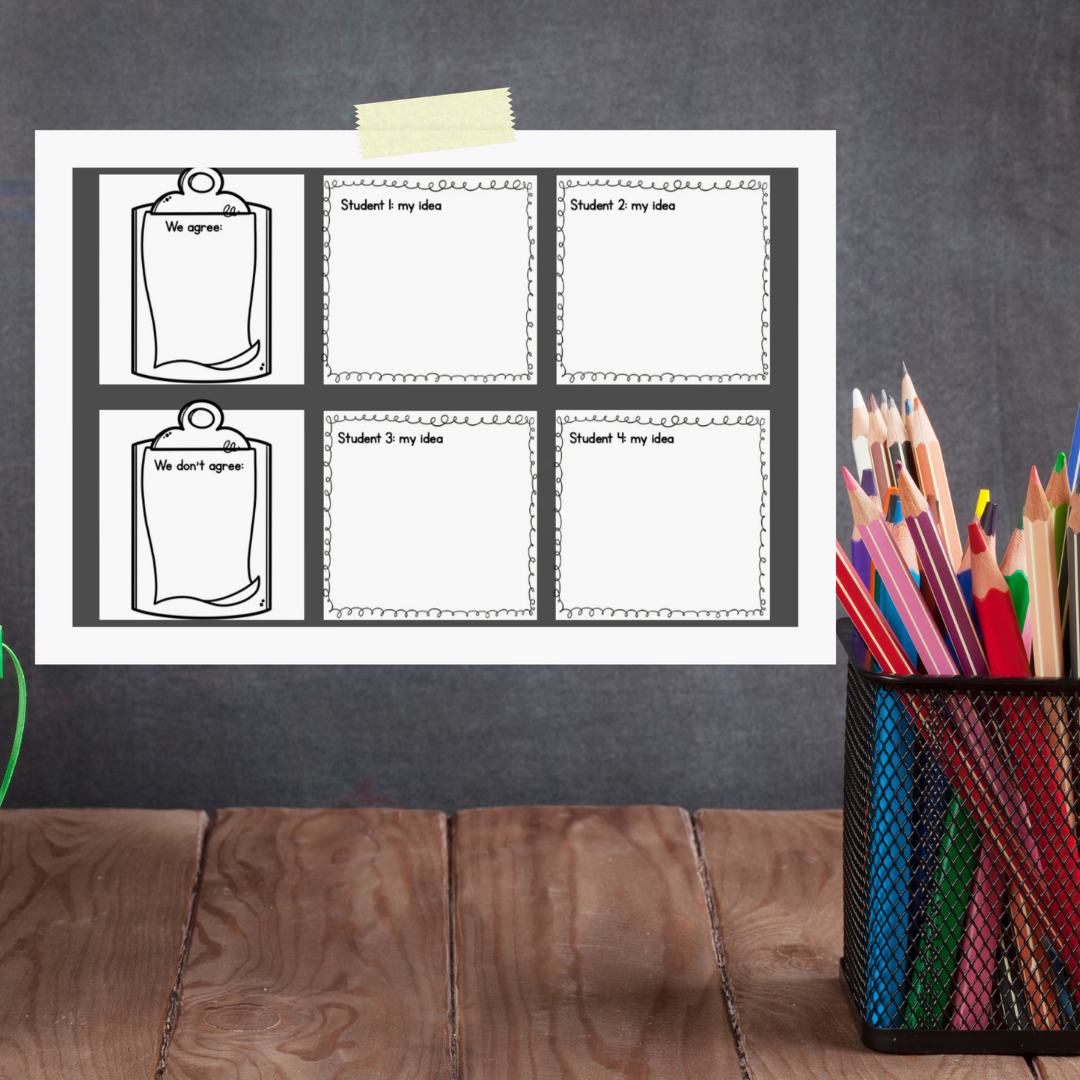
    Cooperative learning only works when every student’s voice is visible. Without structure, group work often defaults to one dominant voice and three silent ones. The free placemat prevents that from happening. Each student has their own idea box and they write their answer independently first, before any discussion begins. Then the group uses the two shared spaces: “We agree” and “We don’t agree”. What stays in the “We agree” space moves forward into the final plan. This format draws on Johnson and Johnson’s cooperative learning research (1994), which identifies individual accountability as the key factor separating productive group tasks from passive ones. Every student writes. Every student contributes to the discussion. The placemat makes that non-negotiable. It works for Phase 1 of this unit, and it works for any group task you run, regardless of topic or level.

    3. Phase 1 — Build the Perfect Holiday

    Best for: A2-B1 groups, 25-30 minutes of active work

    The class divides into 4 groups. Each group is a travel agency. Each agency receives a client profile card — a fictional character with specific holiday wishes: a family looking for a beach holiday on a budget, a couple wanting cultural visits and fine dining, a group of teenagers after adventure activities. The agency’s job: design the perfect 7-day itinerary for their client. They use the 5 sets of thematic flashcards as a working reference throughout:

    🏖️ Beach: sand, sunscreen, towel, waves, umbrella

    🏨 Accommodation: hotel, hostel, campsite, bed and breakfast,

    ✈️ Transport: plane, train, ferry, camper van,

    🎫 Activities and visits: museum, zoo, surfing, hiking,

    📆 Planning holidays: passport, travel guide, to book online,

    Students fill in their Phase 1 worksheet: destination, accommodation, transport, daily programme. The placemat runs alongside this: students note their individual ideas first, then use the “We agree / We don’t agree” spaces to build their group’s final plan.

    At the end of Phase 1, each agency presents their holiday package to the class. This adds a natural speaking element: groups describe their client, their destination, and their itinerary. The other groups are the audience and they already want to know how each client’s holiday turns out.

    What makes this phase effective: every decision requires vocabulary. There is no way to complete the worksheet without accessing the flashcard sets. The cards are not an intro activity put away after five minutes. They stay on the desk and they stay useful throughout.

    4. Phase 2 — The Holiday Crisis

    Best for: 20-30 minutes of active work.

    The clients have left. The holidays have started. And then something goes wrong. Each agency receives a holiday crisis card:

    • The hotel is overbooked. Find alternative accommodation tonight.
    • The flight is cancelled. How does the client get there?
    • The planned activities are all closed for a local festival. What replaces them?

    Groups must revise the holiday they built in Phase 1, solving the crisis using the same vocabulary, adapting the same itinerary. The constraint is real: they cannot start from scratch. They have to fix what they built. This is where the vocabulary genuinely consolidates. Students are no longer recalling words from a list. They are deploying them under light, enjoyable pressure, that is to say the pressure of solving a problem that matters within the game.

    The energy in the room during Phase 2 is something else. Students argue (in English) about whether a hostel or a campsite is the better solution. They negotiate. They refer back to the flashcards without being asked to. The language is working the way language actually works.

    5. What Students Actually Practice (Without Realising It)

    This unit covers all four language skills in an integrated, communicative framework:

    • Vocabulary: 5 thematic sets, referenced actively across both phases,
    • Reading: client profile cards and crisis cards, level-appropriate,
    • Writing: Phase 1 itinerary worksheet and Phase 2 revised plan,
    • Speaking: group negotiation, consensus building, final presentations,
    • Critical thinking: problem-solving under real constraints.

    It is not a filler activity for the last week. It is a genuine communicative task that uses English the way English gets used, with fun in the classroom.

    6. What’s Inside the Mini-Unit

    Everything you need to run both phases:

    🌴 5 sets of thematic flashcards: beach, accommodation, transport, activities, planning,

    📒 Teacher’s notebook: step-by-step instructions, timing guide, group management tips,

    📝 Phase 1 worksheet: instruction sheet (one per agency),

    📝 Phase 2 worksheet: crisis resolution sheet (one per agency),

    🧳 4 client profile cards: one per group, different wishes and constraints,

    🚨 Holiday crisis cards : one per group, triggering Phase 2.

    Print-ready. No extra prep, no materials to source. Open the file, print, run.

    7. Grab Your Free Resource

    Start with the free group work placemat and use it in Phase 1, or use it for any group task in your classroom this week.

    It works for every level, every topic, any time you want every student’s voice in the discussion.

  • 7 Saint Patrick’s Day ESL Activities Your Students Will Actually Love

    Saint Patrick’s Day is one of those themes that just gets students excited. The colors, the legends, the vocabulary — it’s the perfect excuse to make your ESL classroom a little more fun without sacrificing learning. Let’s have a look at these 7 Saint Patrick’s Day ESL activities your students will actually love.


    7 Saint Patrick's Day ESL Activities Your Students Will Actually Love


    🍀 KEY TAKEAWAYS

    ✅ 7 ready-to-use Saint Patrick’s Day activities for A1–A2 ESL learners

    ✅ Covers vocabulary, reading, speaking, memory & game-based learning

    ✅ Works for in-person, hybrid and fast-finisher contexts

    ✅ Free crossword + wordsearch to download below 👇


    📋 Table of Contents


    → 1. Vocabulary Flashcards

    → 2. Dominoes

    → 3. I Have, Who Has

    → 4. Spot & Bark (Dobble-style)

    → 5. Kim’s Game

    → 6. Boom Cards – Vocabulary

    → 7. Boom Cards – Reading activity

    → 🎁 Grab Your Free Activities

    Whether you’re teaching 8-year-olds or teenagers, Saint Patrick’s Day lands every time. Below are the 7 activities I created for my A1–A2 bundle — with tips on how to actually use them in class, not just print them and hope for the best.

    👉 Download the free activities


    1. 🃏 Vocabulary Flashcards

    Best for: whole class warm-up or pair work review

    If there’s one resource I always start with, it’s the flashcards. Saint Patrick’s Day has specific vocabulary students don’t encounter every day — leprechaun, shamrock, pot of gold, fiddle — and flashcards make it visual and memorable.

    🐾 Classroom activity: The Relay Race

    This one is loud, fast, and students BEG to play it again.

    1. Divide the class into 2 or 4 teams.
    2. Give them 2 minutes to study the flashcards as a group.
    3. Then, in a queue at the board, each student writes ONE word from the flashcards — without repeating what the previous teammate wrote.
    4. Timer: 1 minute per round. Most words on the board wins.

    It activates memory, spelling and team dynamics all at once. Works beautifully as a 10-minute starter.

    2. 🁽 Dominoes 

    Best for: small groups of 2–4 students

    20 cards. Simple rules. Huge engagement. Dominoes work because students have to actively recognize vocabulary — both the image AND the word — to make a match.

    How to play:

    • Each player draws 5 dominoes. The rest become the pile.
    • The first player places a domino on the table.
    • The next player matches either the word or the image on either end.
    • No match? Draw from the pile.
    • The first player with no dominoes left wins.

    It’s low-prep, high-interaction, and it runs itself once you explain the rules once.

    3. 🗣️ I Have, Who Has

    Best for: whole class — great for listening and speaking

    This is a classic for a reason. Every student holds a card. One student reads theirs, and the student whose card matches has to respond. It goes around the whole class.

    Example: “I have Saint Patrick. Who has snake?”

    Nobody can zone out — everyone has to listen for their card. Perfect for a Friday activity or a review session before a holiday.

    4. 🐕 Spot & Bark (Dobble-style)

    Best for: group of 3 students — fast-paced and competitive

    This is my corgi-themed version of Dobble. 21 cards, 5 symbols each — and every two cards always share exactly one matching symbol. Students race to spot it first and name it in English.

    The beauty of this game: it’s pure vocabulary recognition under pressure. Speed, focus, and English all at once. Students don’t even realize they’re studying.

    Works great as a brain break or a reward activity.

    5. 🧠 Kim’s Game

    Best for: whole class — memory + vocabulary

    Kim’s Game is a memory classic adapted for ESL. Show students a grid of Saint Patrick’s Day images. They study it carefully. Then one image disappears — and they have to name the missing one in English.

    🎯 Objectives:

    • Develop memory skills
    • Reinforce vocabulary
    • Works with the whole class simultaneously

    You can make it harder by removing multiple images or by asking students to write the missing words instead of just saying them.

    6. 💻 Boom Cards – Vocabulary

    Best for: fast finishers, homework, or independent work

    In this digital deck, students see a Saint Patrick’s Day image and have to circle the correct word from a list. Leprechaun? Shamrock? Pot of gold? They choose.

    ✅ Self-paced  ✅ Automatic correction  ✅ No printing needed

    This is what I hand to fast finishers so they stay on task while I help other students. It also works perfectly as a formative evaluation or homework — students get instant feedback without waiting for you to grade anything.

    7. 📖 Boom Cards – Reading Activity

    Best for: reading comprehension — A1–A2 level

    The topic: “What is a leprechaun?” Students read a short, level-appropriate text and then answer questions in two formats:

    • True or False statements
    • Drag and drop questions

    It’s engaging, it’s differentiated, and it introduces cultural content in a structured way. Students are always curious about the leprechaun legend — this turns that curiosity into a reading exercise.

    Like all Boom Cards, it’s self-correcting and can be assigned digitally.

    🎁 Grab Your Free Saint Patrick’s Day Activities

    Before you go — I made two free resources you can use this week:

    • A Saint Patrick’s Day crossword (key vocabulary)
    • A Saint Patrick’s Day wordsearch (same vocabulary set)

    Both are ready to print and use with A1–A2 learners.

    👉 Download the free activities

    — It’s free — just click and download


    🍀 Want all 7 activities in one go?

    The full Saint Patrick’s Day bundle (A1–A2) includes everything covered in this post: flashcards, dominoes, I Have Who Has, Spot & Bark, Kim’s Game + 2 Boom Card decks.

    St. Patrick’s Day ESL Vocabulary & Games Bundle

  • How to Learn ESL Irregular Verbs Easily Using Spaced Repetition

    Mastering irregular verbs can be one of the trickiest parts of learning English, especially for ESL students.

    In this post, you’ll discover how to learn ESL irregular verbs easily using spaced repetition: a proven method to boost long-term retention and make grammar practice more effective.

    how to learn ESL irregular verbs using spaced repetition

    KEY TAKEAWAYS

    • ESL irregular verbs are difficult due to unpredictable conjugation patterns.
    • Grouping irregular verbs into 10 structural patterns reduces cognitive load.
    • Spaced repetition improves long-term retention and transfer to real-world use.
    • A weekly spaced learning schedule helps students retain verbs across the school year.
    • This method is adaptable to different academic calendars and teaching contexts.

    Why Are English Irregular Verbs Difficult?

    English irregular verbs are tricky because they don’t follow standard conjugation patterns. While regular verbs simply take “-ed” in the past tense (e.g., walk → walked), irregular verbs change unpredictably (go → went, see → saw). This inconsistency makes them harder to memorize, especially for ESL learners.

    The good news? There is a systematic way to make learning them easier and faster. Instead of memorizing them randomly, grouping them into patterns and using spaced repetition can help significantly.


    remember English irregular verbs


    The Secret Behind How to Learn ESL Irregular Verbs Easily Using Spaced Repetition

    If you’re wondering how to learn ESL irregular verbs easily using spaced repetition, the key lies in combining pattern recognition with active recall.

    The two main strategies to use are:

    • The 10-Group Strategy – Organizing irregular verbs into logical groups based on their changes.
    • Spaced Repetition – Reviewing them over time to strengthen memory without overwhelming yourself.
    group strategy and spaced repetition

    Grouping Irregular Verbs: The 10-Group Strategy

    Many irregular verbs follow hidden patterns. By organizing them into 10 logical groups, ESL learners can remember them faster. Here’s how they break down:

    GroupExamplesPattern
    The Tripletscut → cut → cut, put → put → putAll three forms are the same
    “-en” Ending Verbsbreak → broke → broken, write → wrote → writtenPast participle ends in “-en”
    “I → A → U” Verbsdrink → drank → drunk, sing → sang → sungVowel shift “I-A-U” pattern
    “-ught” Verbsbuy → bought → bought, teach → taught → taughtPast & past participle end in “-ught”
    “-ne” Ending Verbsdo → did → done, go→ went → gonePast participle ends in “-ne”
    “-n” Ending Verbsdraw → drew → drawn, know → knew → knownPast participle ends in “-n”
    The Twinsdig → dug → dug, win → won → wonPast & past participle are the same
    “-t” Ending Verbsbuild → built → built, dream → dreamt → dreamtPast participle ends in “-t”
    “-d” Ending Verbsfind → found → found, say → said → saidPast participle ends in “-d”
    The 2 Identicalbecome → became → become, come → came → comeInfinitive & past participle are the same

    This grouping method fits perfectly with the strategy of how to learn ESL irregular verbs easily using spaced repetition, as it introduces structure and repetition over time.


    What Is Spaced Learning?

    Spaced learning addresses the “forgetting curve” (Hermann Ebbinghaus, 1885), a concept describing how information is lost over time if not actively reviewed or recalled. By spacing out learning sessions and revisiting material before it is completely forgotten, the brain is forced to work harder to retrieve the information, which strengthens memory retention and facilitates the transfer of knowledge into long-term memory.

    That’s exactly why spaced learning is at the core of ESL grammar—and an essential part of how to learn ESL irregular verbs easily.

    the forgetting curve


    Benefits of Spaced Learning

    • Improved long-term retention: Spaced learning helps learners retain information for longer periods compared to traditional “cramming” or massed practice.
    • Enhanced real-world application: By revisiting material over time, learners can better apply knowledge in practical situations.
    • Active engagement: The method encourages active recall and repeated retrieval, both of which are more effective than passive review—making it a core strategy in how to learn ESL irregular verbs easily using spaced repetition.


    How to Apply Spaced Learning to Irregular Verbs

    Spaced repetition is a scientifically proven technique where information is reviewed at gradually increasing intervals. This method helps move irregular verbs from short-term to long-term memory.

    To help my students master English irregular verbs more efficiently, I designed a spaced learning schedule that introduces verbs in grouped patterns—such as “The triplets,” “The twins,” or “The -en” verbs—and reinforces them over time. Instead of one-off memorization, each group is taught during an initial learning week, followed by strategic review sessions spaced out in the following weeks. This method aligns with cognitive science research, ensuring that students revisit the material just as they’re about to forget it—maximizing retention and minimizing frustration. In the schedule, learning is spread from week 36 (back to school week in early September) to week 26 (before summer holidays), creating a rhythm that supports long-term memory and meaningful language acquisition.

    This spaced learning schedule is available as a free download for ESL teachers who want to help their students learn irregular verbs with spaced repetition. It’s designed to follow a weekly structure, but it’s entirely customizable based on your local school calendar. Whether your academic year starts in August, September, or even January, you can easily adjust the weeks to fit your teaching timeline. This flexible tool allows you to apply the benefits of spaced repetition no matter where you teach—making it perfect for educators across different regions and school systems.


    How to Learn ESL Irregular Verbs Easily Using Spaced Repetition

    If you’re wondering how to learn ESL irregular verbs easily using spaced repetition, this method breaks it down week by week.

    Week 36 – Initial Learning (Group 1: “The Triplets”)

    • Day 1: Introduce the group using the slides provided in the irregular verbs resources. Each slide includes an example sentence to show the verb in context and support understanding.
    • Day 3: Reinforce learning with the interactive notebook and worksheet activities. You can also assign the Boom Cards for independent practice or homework.
    • Day 5: Assess initial understanding with the short test included in the resource pack.

    Week 38 – Spaced Review

    • Conduct a formative assessment using our Kahoot quizzes to review and reinforce the verbs learned in Week 36.

    Week 42 – Speaking Review Activity

    • Have students choose one verb from the “Triplets” group and create their own sentence using it in context. You can turn this into a pair activity, a mini-presentation, or a class game (like “Find Someone Who…”) to encourage oral practice and spontaneous use.

    Week 50 – Creative Review

    • Ask students to write a short story or a paragraph using at least three verbs from the Triplets group. They can then:
      • Read it aloud in pairs or groups (speaking practice),
      • Illustrate their story (visual + linguistic reinforcement),
      • Record themselves and submit it (digital speaking portfolio).

    Week 16 is the perfect time to revisit the Triplets group with a reflection-based task, especially after such a long interval.

    Week 16 – Reflective Review Task

    • Ask students to reflect on their experience with the Triplets group verbs using writing and/or discussion. You can frame it like this:

      “It’s been a while since we studied the ‘Triplets’ verbs. Which ones do you remember naturally? Which ones have you seen or used recently? Share an example.”

    Here is an option:

    • Write a short journal entry with:
      • The verb they remember,
      • Where they saw or heard it,
      • A new sentence using it,
      • Pair-share their answers in a short speaking round.
    • Use sentence starters:
      • “I remembered the verb “put” because I…”
      • “I saw “cut” in a video when…”
      • “I haven’t used “set” in a while, but here’s a sentence…”

    🕓 Note: The exact timing may vary depending on how many hours you teach ESL to your students. The structure is flexible and can be adapted to fit your schedule and students’ needs.

    This is a practical example of how to learn ESL irregular verbs easily using spaced repetition in the classroom.


    Mastering ESL irregular verbs through spaced practice—One Week at a Time

    Teaching irregular verbs doesn’t have to be overwhelming—for you or your students. By using a structured, spaced learning approach and grouping verbs meaningfully, you’re not only simplifying the learning process but also building lasting retention. With thoughtful planning, interactive resources, and regular, low-pressure reviews spaced across the year, your students can genuinely internalize even the trickiest verb forms.

    Whether you’re just starting with the “Triplets” or revisiting them months later, every activity—be it a quiz, a story, or a reflection—helps cement their understanding. And the best part? This approach is flexible. It adapts to your teaching hours, your academic calendar, and your students’ evolving needs.

    So take this free schedule, make it your own, and give your learners the consistency and confidence they need to succeed in English. Because when learning is spaced, success is sustained. It’s a simple yet powerful method for teachers looking for practical answers to how to learn ESL irregular verbs easily using spaced repetition.


    schedule free download


    🧡 Irregular verbs resources you may like:

    23-en irregular verbs useful bundle

    16-d irregular verbs useful bundle

    10-n irregular verbs useful bundle

    3-ne irregular verbs useful bundle

    23-t irregular verbs useful bundle

    6-ught irregular verbs useful bundle

    7 i-a-u irregular verbs useful bundle

    6 twins irregular verbs useful bundle

    4 two identical irregular verbs useful bundle

    10 triplets irregular verbs useful bundle

    10 interactive notebooks: the fun way to learn English irregular verbs


    🎮 Kahoot Simple Past Games: Master Irregular Verbs Past Tense !

    Irregular Verbs on Kahoot


    How do you learn ESL irregular verbs your ESL students? Share your experiences in the comments below!

  • Master Country Names & Capitals: The Ultimate ESL Geography Quiz

    Learning geography in an ESL classroom can be challenging, especially when country and capital names differ from students’ native languages. However, integrating interactive tools like Kahoot! can make this process engaging and effective. 

    From visual learners to competitive spirits, Master Country Names & Capitals: The Ultimate ESL Geography Quiz brings every student into the learning process.

    how to learn country names and capitals in English

    KEY TAKEAWAYS

    • This page provides an ESL geography quiz resource focused on mastering country names & capitals.
    • Benefits include vocabulary retention, cultural understanding, and classroom engagement.
    • Uses Kahoot! as the primary interactive tool.
    • Designed for A1-B2 ESL/EFL learners.

    Why Geography Matters in ESL Teaching

    Mastering country names and capitals in English is more than map work, it’s the foundation of cultural understanding and practical ESL learning. When students learn countries and capitals in English, they:

    • Build practical vocabulary they can use in conversations,
    • Develop confidence discussing global topics,
    • Connect language learning to real-world knowledge (travel, etc.),
    • Engage with cultural contexts that give meaning to the language.

    However, the traditional approach of memorizing lists of countries and capitals often falls flat, especially when students encounter terms that differ significantly from their native language.

    learning capitals of the world

    Why Country Names and Capitals Poses a Unique Challenge for ESL learners

    The names of countries and capital cities often differ from one language to another, making geography an especially rich and sometimes confusing topic for language learners.

    Consider these examples:

    EnglishOther Languages
    GermanyDeutschland (German)
    JapanNihon/Nippon (Japanese)
    GreeceHellas (Greek)
    FinlandSuomi (Finnish)

    This phenomenon-where a place has different names in different languages-is known as exonyms (the name used by outsiders) and endonyms (the name used by locals). Understanding these differences helps students:

    • Recognize the diversity of languages and cultures.
    • Avoid confusion when encountering place names in various contexts.
    • Appreciate the importance of language in shaping our view of the world.


    country name challenge


    Interactive Learning: The Game-Changer for ESL Geography

    Kahoot! transforms the learning experience by turning quizzes into interactive games. This approach has been shown to enhance student engagement and motivation. According to a study published in the World Journal of English Language, using Kahoot! in ESL lessons led to significant improvements in student performance and interest.

    By incorporating game elements, Kahoot! encourages active participation, making it easier for students to absorb and retain information. The immediate feedback provided during quizzes helps reinforce learning and correct misunderstandings in real-time.

    make geography fun with kahoot


    Master Country Names & Capitals: Transform ESL Lessons with Kahoot

    Kahoot has revolutionized how we teach geography in ESL classrooms. These gamified quizzes turn potentially dry content into exciting classroom competitions that students genuinely look forward to.

    With our ultimate ESL geography Kahoot quizzes, you can:

    • Reinforce vocabulary through visual associations and repetition,
    • Create friendly competition that motivates students to learn,
    • Provide instant feedback that helps correct misconceptions,
    • Track progress to identify areas needing more attention.
    What Our ultimate ESL Geography Quiz Covers:
    1. Flag Recognition – Visual association to reinforce country names.
    2. World Capitals Challenge – Test knowledge of major capital cities.

    Make geography lessons unforgettable with Master Country Names & Capitals: The Ultimate ESL Geography Quiz—your go-to resource for effective ESL teaching.


    How to Implement Geography Quizzes in Your ESL Classroom

    Integrating these ESL geography Kahoot quizzes into your lessons is simple:

    1. Warm-up Activity: Start class with a quick 5-minute geography quiz to energize students,
    2. Review Session: Use quizzes to reinforce previous lessons,
    3. Team Challenge: Create groups to encourage collaboration and peer learning,
    4. Progressive Learning: Begin with basic country names and advance to more complex geographical concepts.


    smart ways to use kahoot


    Master Country Names & Capitals: The Ultimate ESL Geography Quiz is designed to make learning global vocabulary engaging, memorable, and effective for English language learners.


    Beyond Memorization: Building Cultural Bridges

    The true power of these geography quizzes extends beyond vocabulary acquisition. They create natural opportunities for cultural discussions:

    • Why is the English name for a country different from what locals call it?
    • What historical connections explain geographical naming patterns?
    • How do geographical features influence culture and language?

    These discussions transform simple vocabulary lessons into rich cultural exchanges that improve both language skills and global awareness.


    Ready to Transform Your ESL Geography Lessons?

    If you’re looking for a fresh way to engage your ESL learners, Master Country Names & Capitals: The Ultimate ESL Geography Quiz is exactly what your classroom needs. These classroom-tested resources include 12 ready-to-use Kahoot quizzes to help students master country names and capitals quickly and confidently.

    inside esl geography quiz

    Master country names & capitals with our ultimate ESL geography quiz!


    Don’t let geography be the forgotten component of your ESL curriculum. With the right tools, it can become the most anticipated part of your students’ language learning journey.


    🧡 Kahoot freebies you may also like:

    Fun past tense -ED pronunciation Kahoot game

    Helpful Kahoot game for practicing BE and HAVE verbs

    Fun Capital cities Quiz Kahoot for English speaking countries

    Fun Kahoot Game for practicing the verb BE


    🎮 Browse Games on Kahoot!


    How do you make geography engaging in your ESL classroom? Share your experiences in the comments below!