Key Takeaways
- ESL Halloween activities for A1-A2 learners work best when they combine visual vocabulary support, repetition, and speaking practice. This article presents five classroom-tested activities built around those three pillars.
- The five activities are: Halloween vocabulary flashcards, an “I have, who has” card game, a definition-based speaking game, a Dobble-inspired matching game called “Spot & Bark”, and a guided “were-animal” creative writing task.
- Each activity is grounded in a teaching method: explicit teaching for the flashcards, cooperative classroom for the card games, problem-solving for the definition game, and Freinet’s student publishing for the writing task.
- The activities recycle the same 24-word Halloween word set (witch, skeleton, bat, pumpkin, vampire, spider, black cat, ghost, broomstick, candy, cauldron, coffin, graveyard, haunted house, monster, mummy, potion, tombstone, zombie, full moon, lollipop, skull, spider web, werewolf), so students meet every word at least three times in one lesson sequence.
- The full sequence fits one 55-60 minute ESL Halloween lesson, or you can split the activities across the week as warm-ups, main tasks, and fillers.
- These activities target beginner (A1) and elementary (A2) learners, require no preparation beyond printing, and work with whole classes or small groups.
Table of Contents
1. Why I Built These Halloween Activities
ESL Halloween activities are classroom tasks that teach English through Halloween vocabulary and themes. I used to struggle with themed lessons at A1-A2 level: the vocabulary is new, the words are hard to pronounce (graveyard, cauldron, werewolf), and my students lost interest the moment the lesson became a word list. So I did what I always do when something does not stick in my classroom: I read about pedagogy, I picked the methods that fit the problem, and I built the activities myself with gamification in mind. That is how this Halloween bundle was born, and that is why each activity below comes with the method behind it, not just the instructions.
Halloween has one big advantage for beginners: it gives students a high number of concrete, imageable nouns. A pumpkin, a bat, or a ghost can be shown in one picture, so students can learn 20+ new words in a single lesson without translation. The strategic payoff for you: this one word set then feeds every other skill you teach in October, from speaking games to creative writing.
2. Activity 1: ESL Halloween Vocabulary Flashcards (Explicit Teaching)
Level: A1-A2 | Skill: Vocabulary acquisition | Time: 10 minutes | Format: Whole class
How it works: Show each flashcard, say the word, and have the class repeat it twice. Then flip the routine: show the card and wait for students to produce the word before you confirm it.
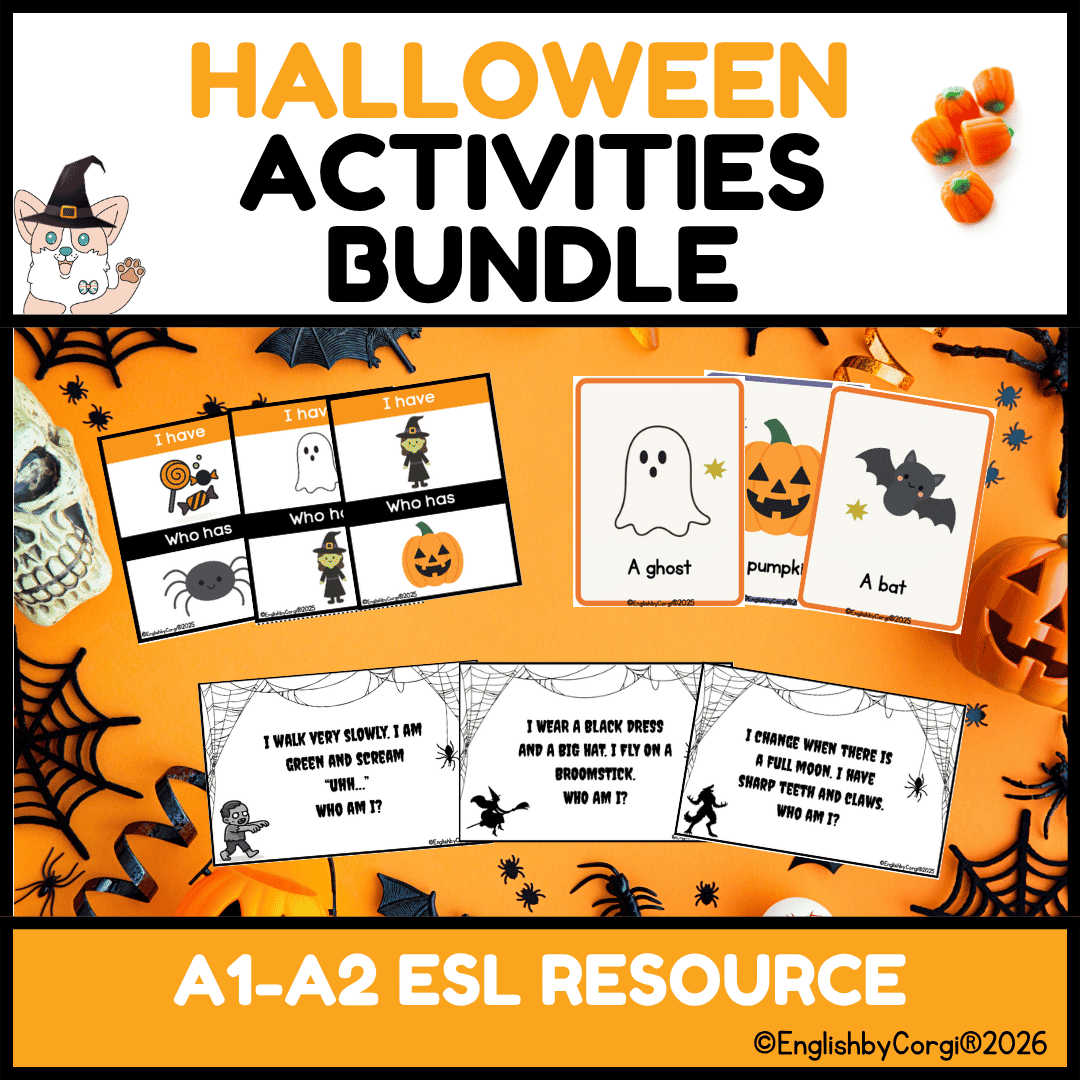
The method behind it: Flashcards alone are just direct vocabulary presentation. What makes this activity explicit teaching is the sequence, and I structure it in three steps on purpose. My flashcards show the image and the word, and that format drives the whole sequence. Step 1, modelling: I show the card with both image and word, I say the word, the class repeats twice, with no guessing. Step 2, guided practice: the cards stay fully visible, and the class reads the words together, so errors surface while I can still correct them immediately. Step 3, checking: I hide the word and show the image only, so students have just the visual cue and must recall the word before I confirm anything. That third step is the one I used to skip, and it is the one that matters: as long as the word is visible, students read and feel like they know it. Once I cover the word, only real memory produces the answer, and that is what tells me who actually acquired the word. This structure is exactly what explicit teaching recommends, a clear model, guided practice, then a check for acquisition, and the flashcards are simply the material that carries it. My 24-card set (witch, skeleton, bat, pumpkin, vampire, spider, black cat, ghost, broomstick, candy, cauldron, coffin, graveyard, haunted house, monster, mummy, potion, tombstone, zombie, full moon, lollipop, skull, spider web, werewolf) deliberately pairs high-frequency words (candy, cat) with theme-specific ones (cauldron, tombstone), so every student starts with a few words they already know.
Extension 1: Once the class knows the cards, add simple adjective phrases: “a big orange pumpkin”, “a small black spider”. This pushes A2 students toward descriptive language with zero extra material.
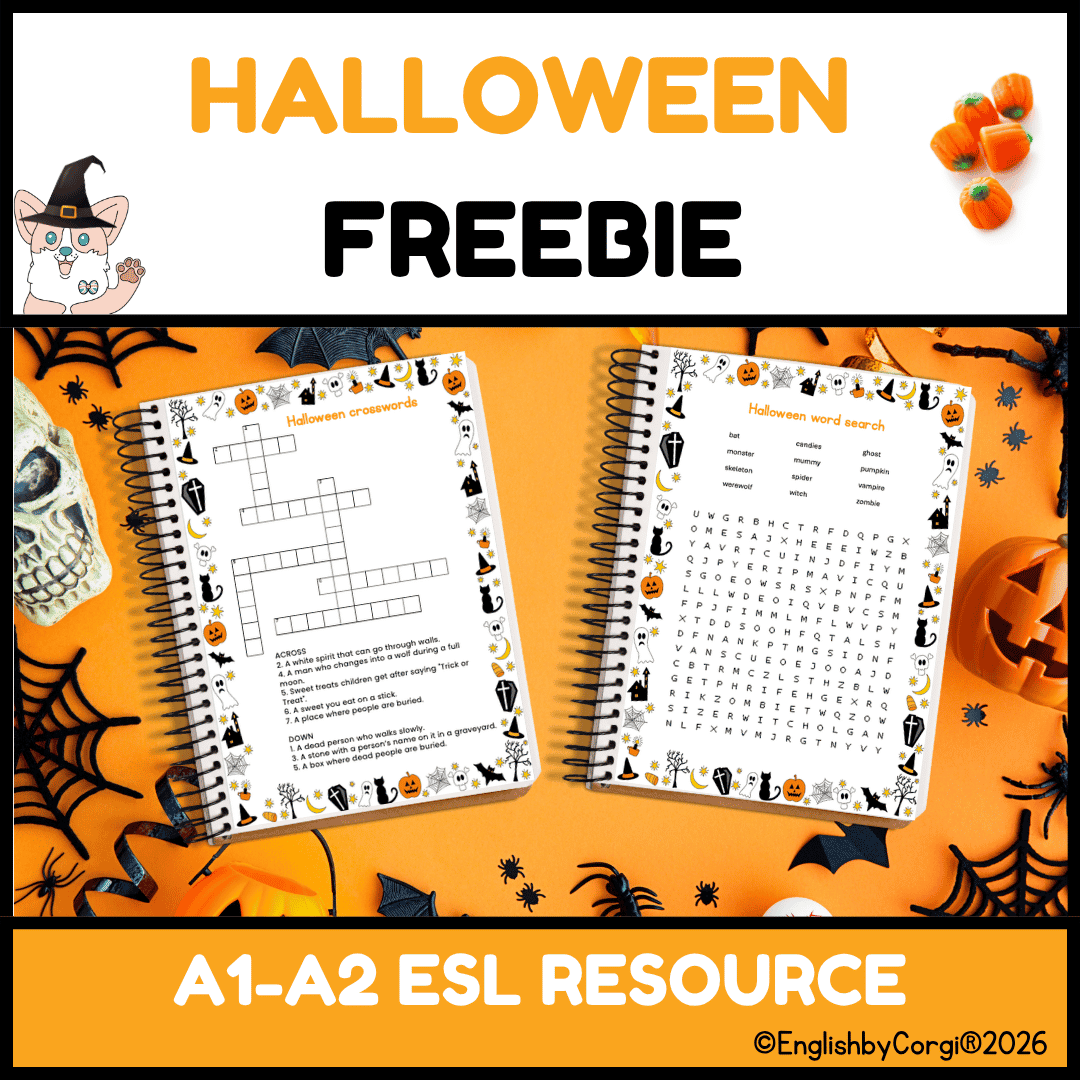
Extension 2, independent practice: Once the class has the words, I hand out worksheets for quiet consolidation, a crossword for meaning and spelling, and a word search for fast recognition. Because the crossword asks students to produce the words with no visual support, it doubles as a quick check of who actually acquired the vocabulary.
3. Activity 2: “I Have, Who Has” Halloween Game (Cooperative Classroom)
Level: A1-A2 | Skill: Listening and speaking | Time: 10 minutes | Format: Whole class, seated
How it works: Each student receives one or more cards. The first player reads “I have a ghost. Who has a pumpkin?” and the student holding the pumpkin card continues. The chain closes when every card has been read.
The method behind it: This game comes straight from the cooperative classroom approach. Every single student is responsible for one link in the chain, so nobody can hide and nobody is left out. It is also the strongest listening activity in the set: students must recognize the vocabulary by ear alone, with no picture support. And because the sentence structure is fixed (“I have a ghost”), A1 students focus all their attention on listening and pronunciation instead of grammar. That is why I keep this game in my routine every October.
My tip: Time the round, then play a second time and challenge the class to beat their own record. The competitive framing keeps fast finishers engaged and gives slower processors a second exposure to every word.
4. Activity 3: Halloween Definitions Speaking Game (Problem-Solving)
Level: A2 (A1 with support) | Skill: Speaking and listening | Time: 10 minutes | Format: Small groups
How it works: One student reads a definition aloud, for example: “It is a person. It sleeps in the day and drinks blood at night.” The other students race to name the word: vampire.
The method behind it: This is a problem-solving task. The listeners get clues and must combine them to reach the answer, which trains decoding meaning from language instead of from a picture. That is a meaningful step up from flashcards, and it is exactly the bridge between A1 recognition and A2 production. The reader also practices fluency with a prepared text, so both roles work hard in the same round.
My tip: Keep the definitions at A1 level even though the task suits A2. Simple structures (“It is a place. It is old. Dead people are there”) work better than rich descriptions, because the listening load should be the vocabulary itself, not the grammar of the definition.
5. Activity 4: Dobble-Inspired Halloween Matching Game (Speed and Automatic Retrieval)
Level: A1-A2 | Skill: Visual discrimination and speaking | Time: 10 minutes | Format: Groups of 3-4
How it works: Each card shows several Halloween pictures, and any two cards share exactly one identical picture. Players reveal two cards, and the first to spot and name the matching picture wins the pair. Naming, not spotting, wins the point, so a student who sees the bat but cannot say “bat” does not score.
The method behind it: I hesitated before creating this one, and here is why I did it anyway. Speed games force automatic retrieval, which is the difference between a word students recognize and a word students own. Repetition is the principle behind the whole game: because the same 24 words reappear across every card, students produce each word many times in ten minutes, more than in any drill I know. I wondered how I could make vocabulary stick, and this is my answer for the students who need to say the words, not just see them.
My tip: Require a short phrase instead of the bare word for A2 groups: “a black cat” rather than “cat”. This adds article use and adjective placement without slowing the game down.
6. Activity 5: “Were-Animal” Creative Writing Task (Freinet and Student Publishing)
Level: A2 (A1 with the writing frame) | Skill: Writing and imagination | Time: 15-20 minutes | Format: Individual, then class book
How it works: Students read a short model text about werewolves: “In folklore, a werewolf is an individual who can change into a wolf. Transformations are often triggered by the full moon and transmitted by a bite or scratch from another werewolf.” Each student then invents a new creature (a werebunny, a werespider, a weregoat) and writes a short story that answers three questions: why the person changes into that animal, when the transformation happens, and what the creature does when transformed.
The method behind it: This task is inspired by Freinet, and the model text is the key. It supplies the sentence patterns (“can change into”, “is triggered by”, “is transmitted by”) that students copy and adapt, so A2 writers produce a structured story instead of a word list. The invention element (choosing the animal) gives ownership without adding linguistic difficulty, because the grammar of every were-animal story is identical. Freinet’s real insight comes at the end: publish the work. We collect the stories into a class book of spooky were-animal tales and display it in the classroom. My students write differently when they know the class book is real, and they read each other’s stories on their own afterwards, which turns one writing task into a reading resource too.
My tip: Use the graphic organizer with four boxes before writing: the animal, the cause (bite, curse, accident), the trigger (full moon, fear, a sound), and one action the creature does. Students who fill the boxes can write the story. Students who cannot write yet can present theirs orally, so nobody is left out of the fun.
7. How I Sequence the Five Activities in One ESL Halloween Lesson
The order matters, and the logic is simple: input before output. The flashcards introduce the words (input), the three games recycle them by ear and by speech (controlled output), and the writing task turns them into free production. Here is my 55-minute ESL Halloween lesson plan:
| Time | Activity | Method | Purpose |
| 10 min | Flashcards | Explicit teaching | Introduce the 24 words |
| 10 min | I have, who has | Cooperative classroom | First listening pass |
| 10 min | Definitions game | Problem-solving | Meaning-based listening and speaking |
| 10 min | Dobble-inspired game | Repetition and retrieval | Fast, automatic word retrieval |
| 15-20 min | Were-animal writing | Freinet, student publishing | Free written production |
If you prefer ESL Halloween worksheets over games for some of your groups, the flashcards and the writing organizer work as printables: the first for word-level practice, the second for structured writing support.
8. What Your Students Can Do at the End of the Lesson
I always want to know where a lesson lands, so here is what to expect. An A1 student who completes this sequence can recognize all 24 Halloween words in pictures and by ear, say each word in the frame “I have a…”, and name a creature from a simple spoken definition. An A2 student can additionally describe Halloween items with adjectives, and write a short structured story using the patterns “can change into” and “is triggered by”. These are concrete, assessable outcomes, which makes the sequence easy to justify in your lesson plan or to parents.
9. Where to Find the Activities
All five activities are in my print-and-go Halloween bundle for A1-A2 learners: the 24-flashcard vocabulary set, the “I have, who has” game, the definitions speaking game, and the were-animal writing task with its model text and graphic organizer. I created every piece myself, from the word list to the game cards, because I could not find Halloween resources that matched how I teach. Print once, teach every October. Corgi and I hope your students love them.